Archive for February 2025
An EEG hyperscanning study during persuasion toward groupness. The frontal brain area activation as a function of role
Readiness potentials changed by decision-making in the chicken game
My year of long covid: ‘the pandemic isn’t over’
The relationship between borderline personality features and self-efficacy: the mediating role of school adjustment and the moderating role of social support
Evaluating the evidence base for university counseling services and their effectiveness using CORE measures: A systematic review and meta-analysis
Equality: What It Means and Why It Matters

Effects of conditional cash transfers on tuberculosis incidence and mortality according to race, ethnicity and socioeconomic factors in the 100 Million Brazilian Cohort
Bridging Healthcare and Social Services for People Living with Dementia and Their Caregivers
The role of perceived restorative justice understanding and sympathy in a brief restorative justice intervention in prison.
An Aberrant Abundance of Cronbach’s Alpha Values at .70
OECD Toolkit to Combat Homelessness
Challenges to the Future of a Robust Physician Workforce in the United States
Recent Developments in Women’s Health Research at the NIH

Factors associated with gender specific adolescent presentations to the emergency department for suicide risk behaviors during the COVID-19 pandemic
Director’s Innovation Speaker Series: Youth Suicidal Behaviors: Where Do We Go From Here
The QUIC-SP: A Spanish language tool assessing unpredictability in early life is linked to physical and mental health
Pre-post implementation policy support for warnings on cigarette filters in Canada among adults who smoke cigarettes
Writing assistant, workhorse, or accelerator? How academics are using GenAI
Understanding Disability Through Collective Poetry Writing
Early intervention in psychosis programs in Africa, Asia and Latin America; challenges and recommendations
National eco-social policies in the framework of EU just transition: The cases of Greece, Italy, Portugal and Spain
In the balance: Lessons for changing the mix of professions in NHS services
2024 update: Building a more inclusive Australia. Australia’s Disability Strategy 2021-2031
Positive and negative syndromes in schizophrenia: analysis of determinants and severity of symptoms in Moroccan patients
Epistemic Governance in the Context of Crisis: A Complexity-informed Approach
“We can’t allow ourselves to fall ill”: Health and (self-)discipline in female family caregivers from a gender perspective
Evaluation of a Parenting Program for Mothers With a Borderline Personality Disorder: A Multiple Baseline Single-Case Experimental Design Study
Unveiling the Shadows: Interconnection of client violence and turnover intention in Chinese social work chain-mediated effects of fear and affective commitment
2025 Global Outlook | Prospects for Children: Building Resilient Systems for Children’s Futures
Epidemiological methods in transition: Minimizing biases in classical and digital approaches
“Me? At this age?”: A narrative analysis of older South Asian Muslim immigrant women’s subjectivity-formations in migration arrangements
Revisiting Cowgill’s modernisation theory: perceived social status of older adults across 58 countries
An Evaluation on a Mental Health Art Exhibition’s Impact on Reducing Stigma
Justice Social Work Statistics: 2023-24

Justice social work reports (JSWRs)
Earthquake effects on youth: understanding psychological challenges and support needs
A sense of (dis)connectedness: LGBTQ+ online othering on Thai Facebook comments
From a toy to a tool: the reception of Barbie and cultural ambiguity in contemporary Pakistan
Content and Item Response Theory Analysis of ChatGPT-4-Generated Multiple-Choice Items
Esketamine Treatment for Depression in Adults: A PRISMA Systematic Review and Meta-Analysis
Longitudinal effects of helping war refugees on intergroup threat and fear of war: The role of perceived helping functionality
National FASD Program: Social Return on Investment
It’s the Evidence, Stupid: GAO’s Report on Evidence-Based Policymaking and What Comes Next

Screening for Osteoporosis to Prevent Fractures US Preventive Services Task Force Recommendation Statement
Chatbot-Based Mindfulness-Based Stress Reduction Program for University Students With Depressive Symptoms: Intervention Development and Pilot Evaluation
Social Work in the Post-Dobbs Era
Review of Evidence on Alcohol and Health

The psychology of criminal authority: Introducing the Legitimacy of Secret Power Scale
Medicare Advantage networks include few Black or Hispanic physicians, making concordant care inaccessible for many
Citizenship and the Finnish School Radio of the 1930s
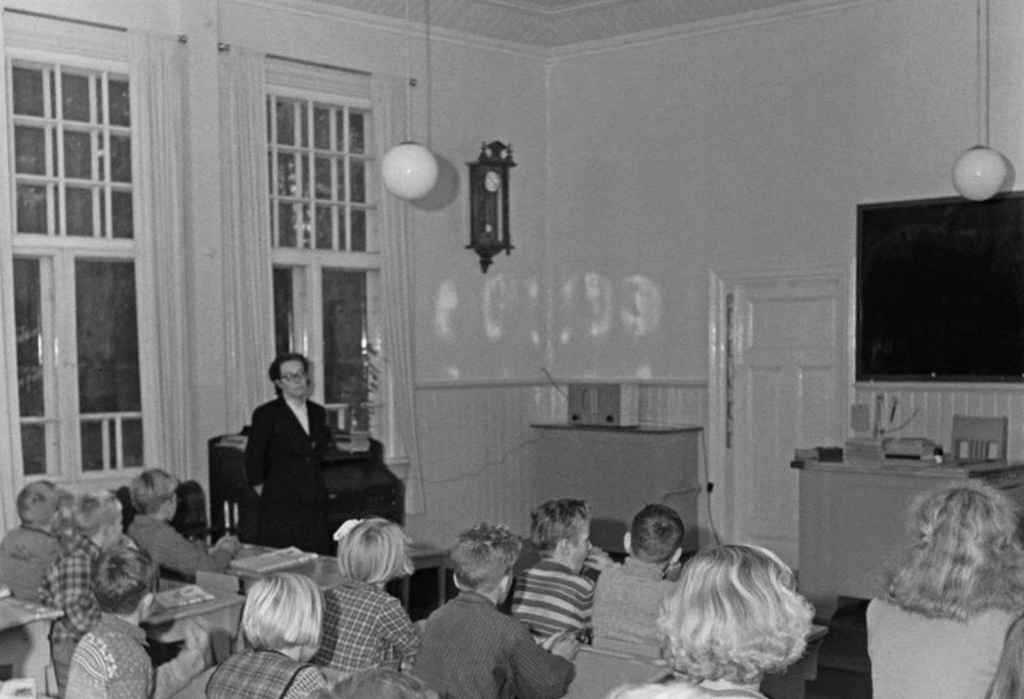
history.ox.ac.uk | B Brandt, Press Photo Archive
The Finnish Broadcasting Company was established in 1926 and the first school radio programmes were aired in the autumn of 1934.[1] One of their explicit aims was to reduce inequalities between urban and rural areas by allowing even “students from peripheral schools to come into contact with leading cultural personalities”. [2] Simultaneously, the school radio was viewed as an incremental tool in strengthening the pupils’ enthusiasm for learning and schoolwork. This was not atypical. As Fleming and Toutant have formulated it, school radio of the 1920s and 1930s was viewed as “‘a modern box of magic,’ an appliance that could make school lessons come to life in a way they never had before”.[3]